From the first interview
to the boardroom.
Riverbend Community Credit Union is a $612 million institution we invented to show what our Business Process Analysis tool does. Follow it from a conversation with the CEO to mapped processes, verified technology dependencies, a modernized wire process and a board dashboard that says, in plain language, where the business is exposed and what to do about it.
Five stages. One connected picture.
Every answer lands in one secure engagement record, so a statement made in an interview can be traced all the way to the risk the board sees.
- STAGE 1
Discover
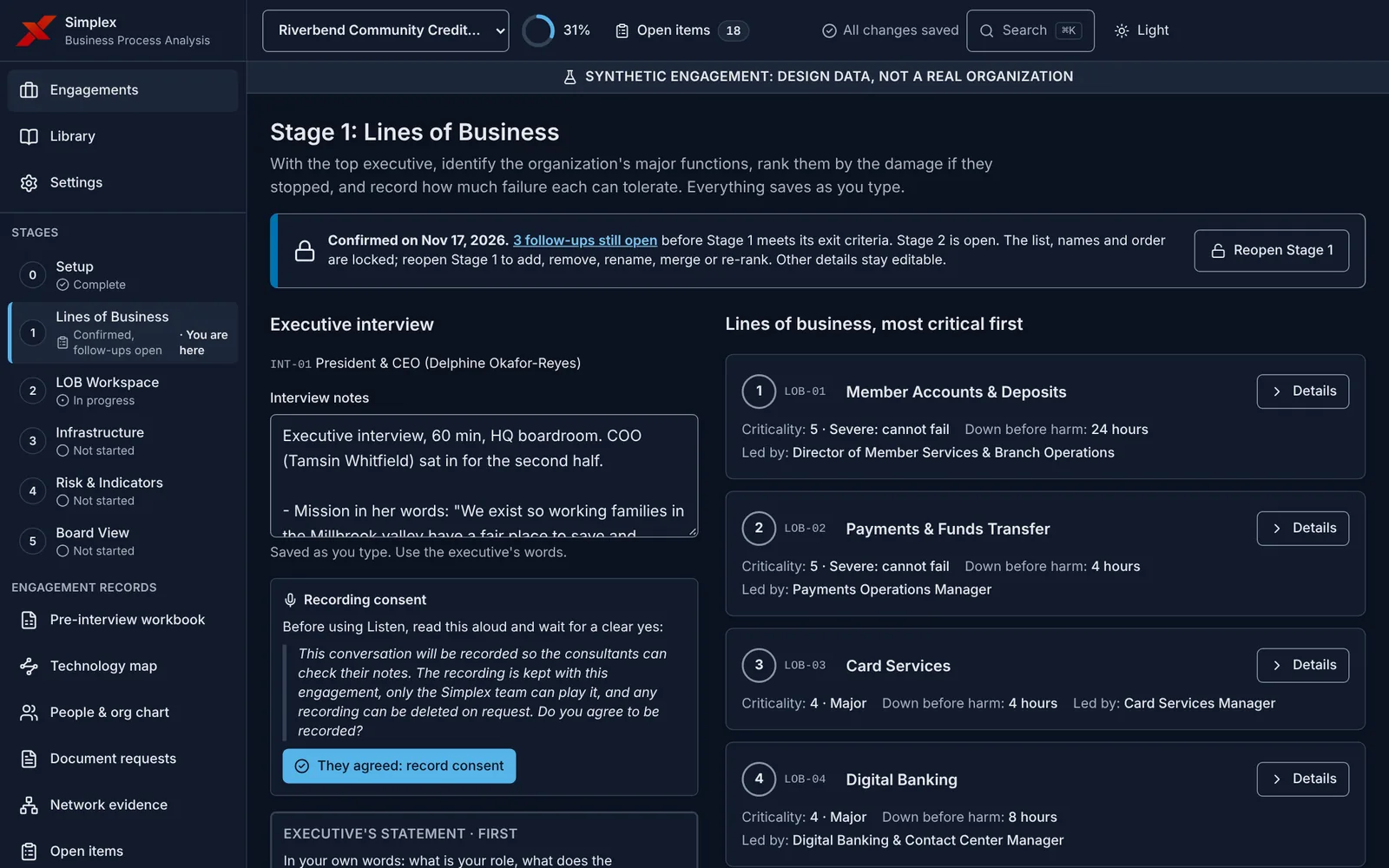
The top executive names the lines of business and ranks them by how fast failure would hurt.
- STAGE 2
Map
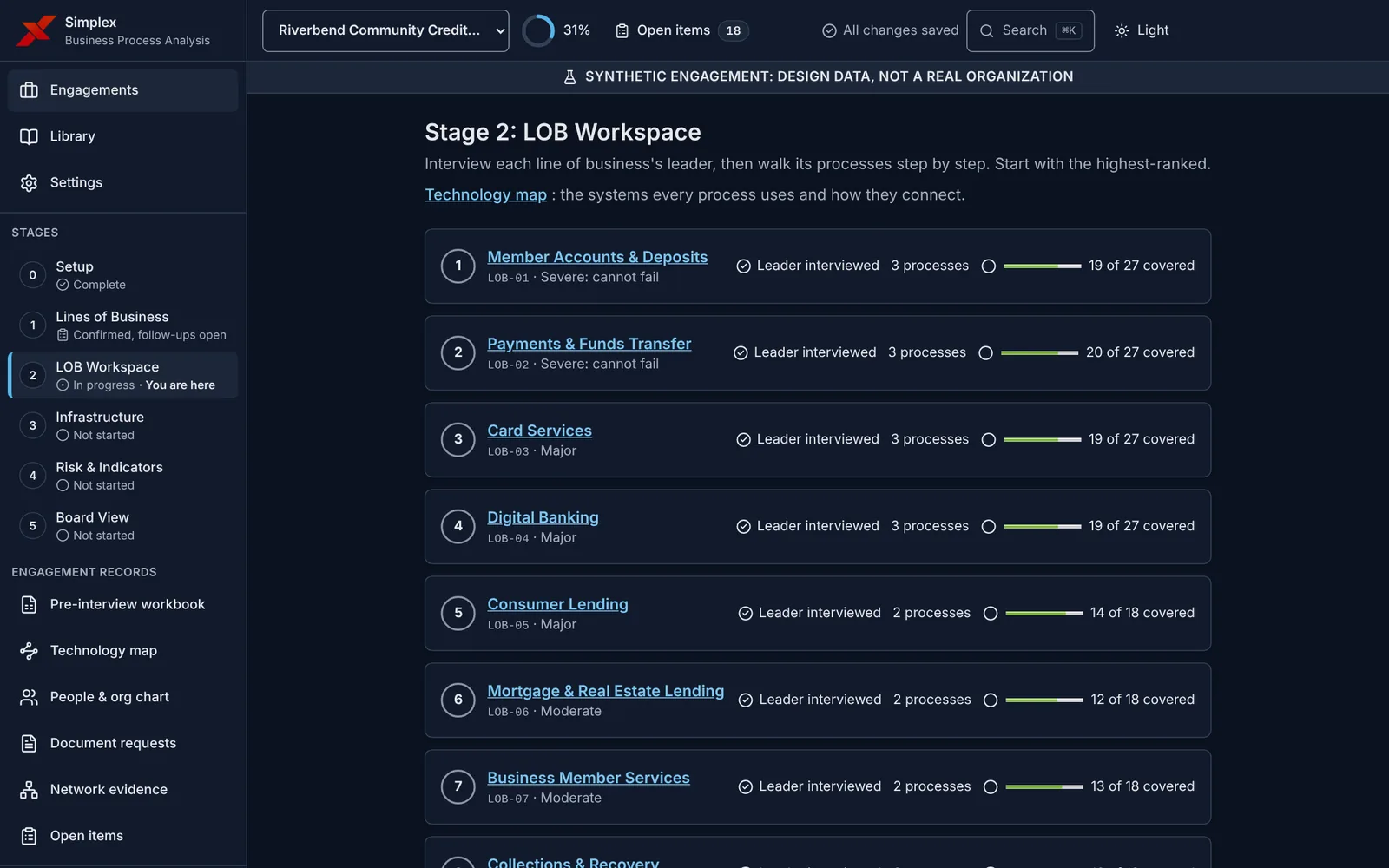
Each leader walks us through people, process and technology, step by step, into swim lanes.
- STAGE 3
Connect
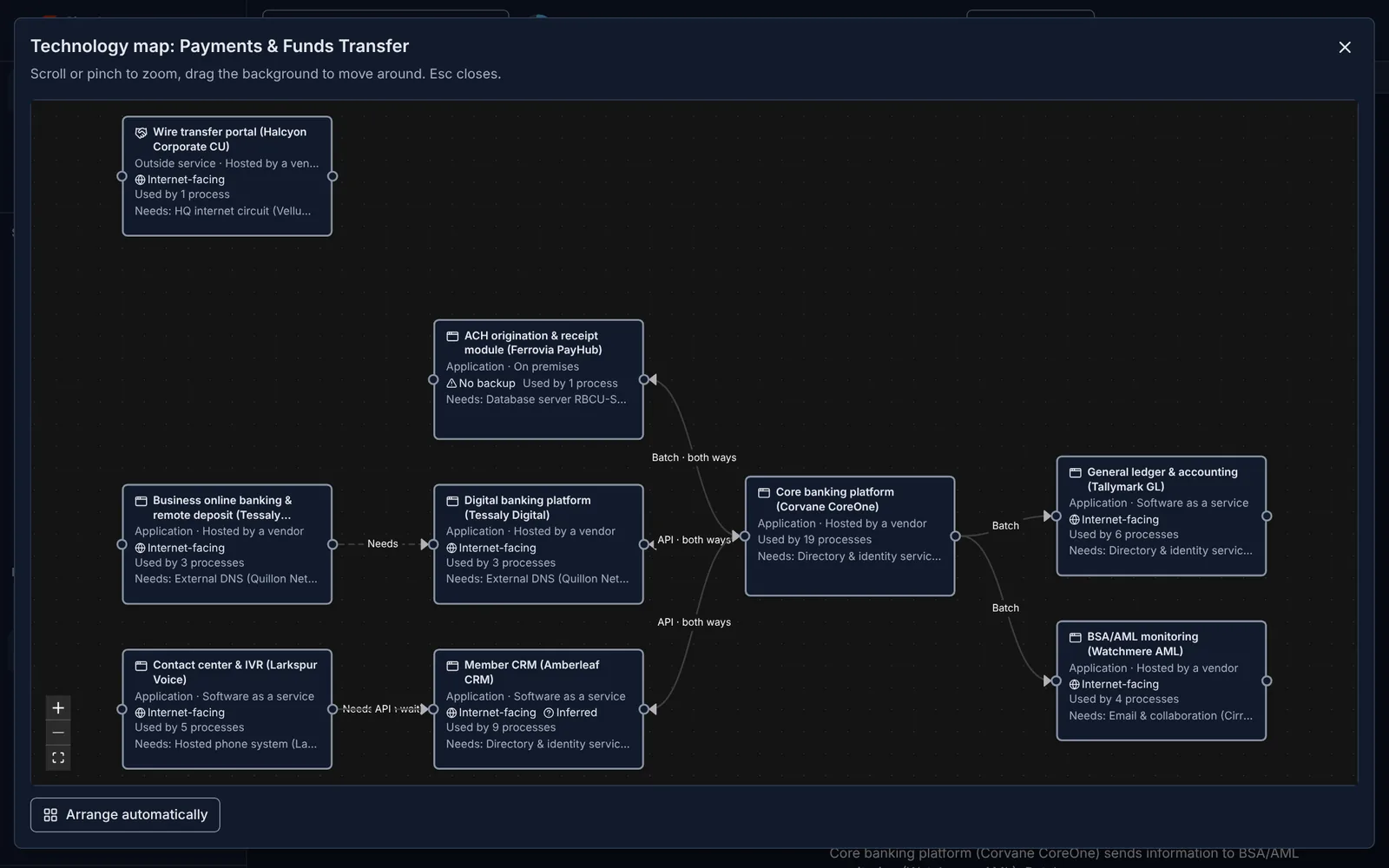
Systems and shared services are linked, so a weakness in one place shows everywhere it lands.
- STAGE 4
Verify
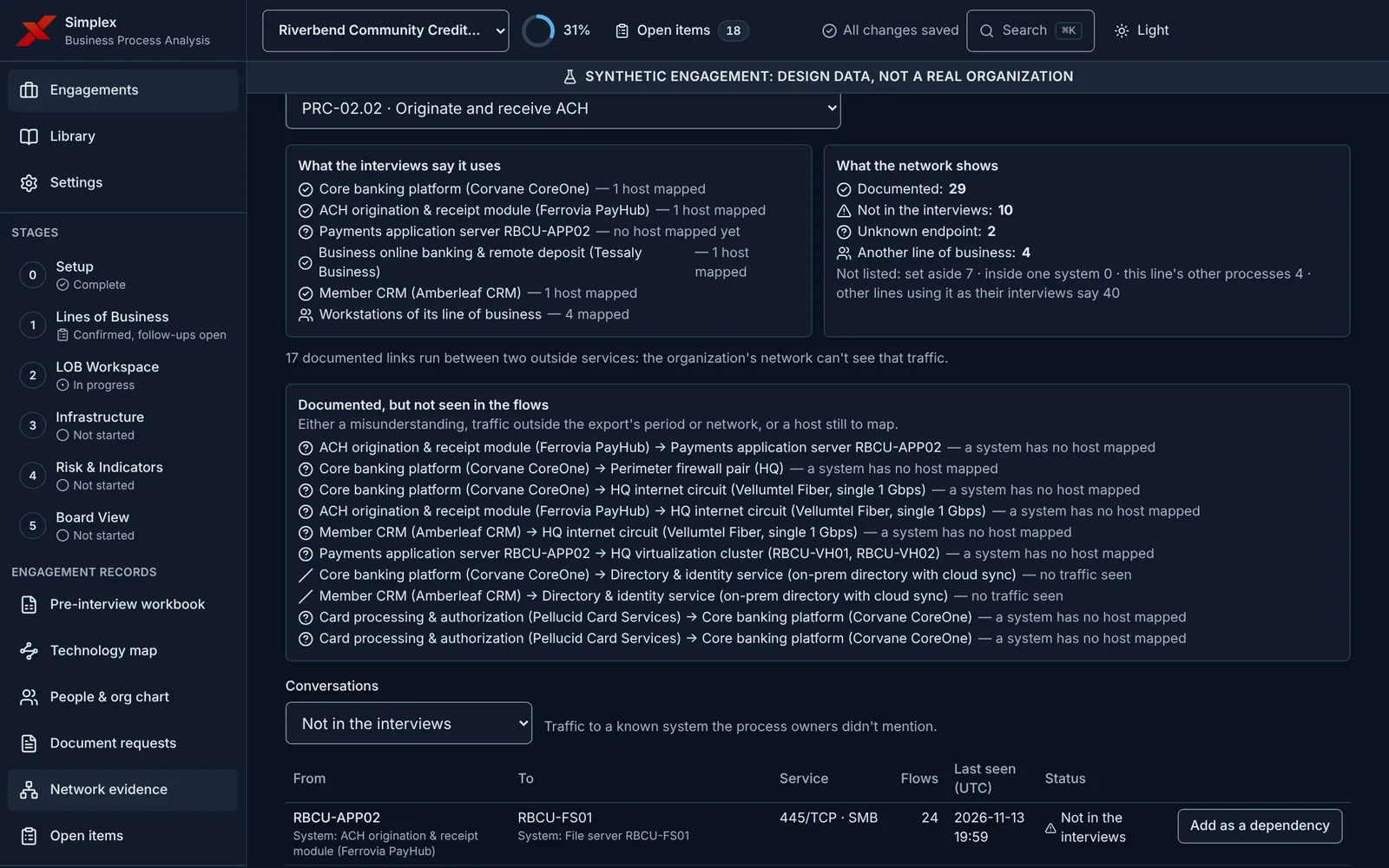
Real network traffic is compared with what people told us, exposing what nobody mentioned.
- STAGE 5
Decide
Findings become plain-language risks, recovery checks and clear asks for the board.
Start where the business starts: with what can't fail.
In a 60-minute session, Riverbend's CEO named eight lines of business and ranked them by the damage of a stoppage. Member Accounts and Payments came out on top: payroll deposits and wires can't wait more than a few hours.
- Criticality and "down before harm" captured in the executive's own words
- Risk appetite recorded up front, so every finding is judged against it
- Gaps and conflicts become owned open items, never guesses
How a wire really gets sent.
The Payments manager described the process step by step. The tool turned it into a swim lane and flagged what a policy manual never shows: everything runs through one trained person on one computer.
No process left half-asked.
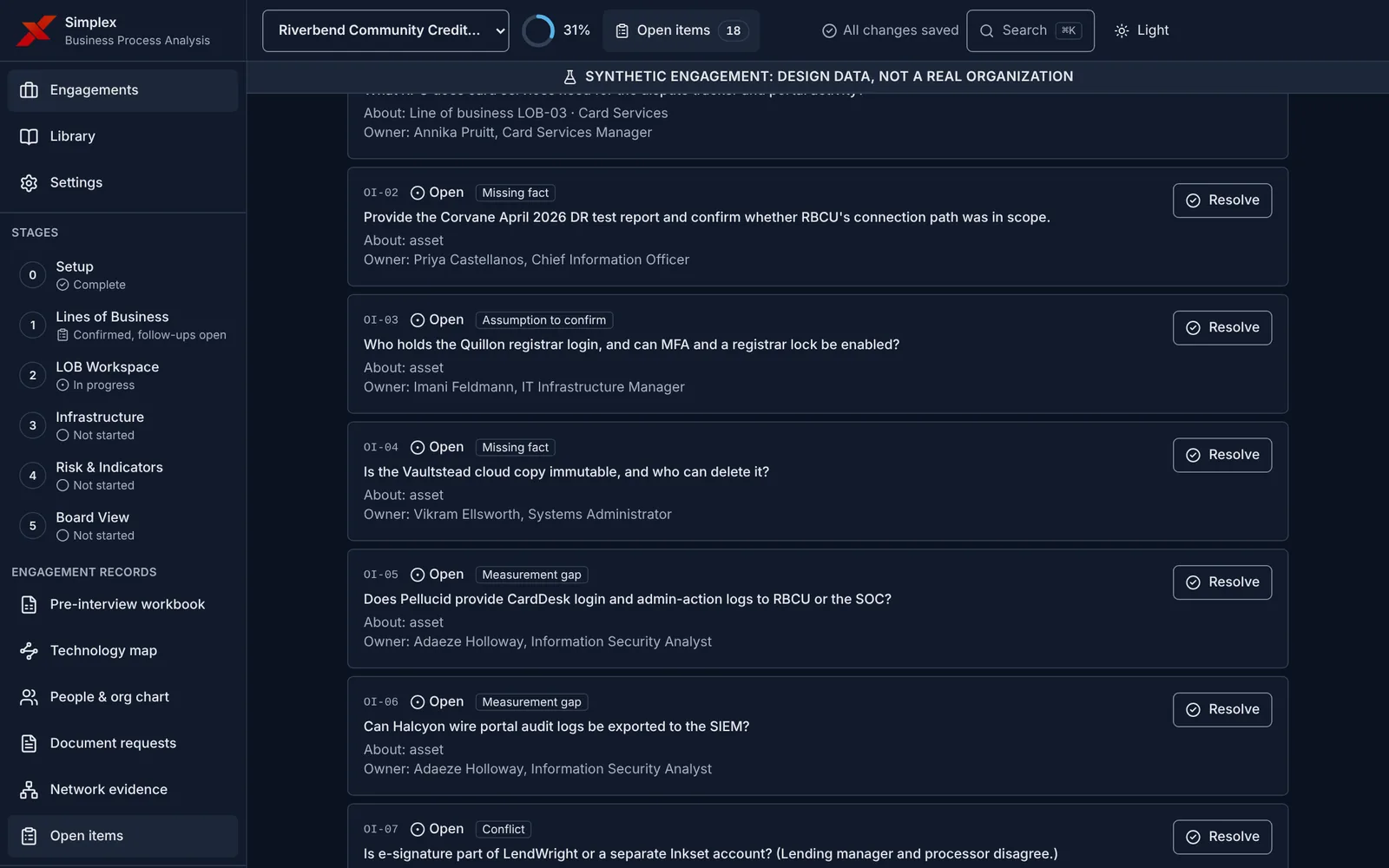
A prescriptive People, Process and Technology question set runs for every process. A coverage meter shows what's still missing, and "I don't know yet" becomes an open item with an owner instead of a blank.
- Roles, systems, decisions and handoffs captured on the spot
- Single points of failure and manual workarounds recorded per step
- Swim lanes export to PDF, Lucidchart and Mermaid
Trust what people say. Then check it.
The technology map shows which systems each process depends on and what information moves between them. Then we import network flow records and compare: documented links that never appear, and real conversations nobody mentioned.
AI does the heavy lifting. People make the calls.
AI is built into the tool where it saves real hours, and every output is reviewed and approved by a Simplex consultant before a client sees it.
Live transcription
With recorded consent, interviews are transcribed as people talk, so consultants listen instead of typing. Off by default per engagement.
Analysis, drafted by AI
From the engagement record, AI prepares interview guides, reconciles conflicting answers and proposes indicators and risk scenarios for the team to review.
Board-language risks
Technical findings are rewritten as "if this happens, here's what the business loses," with jargon blocked from the board view.
A consultant signs off
Nothing AI drafts reaches a client unreviewed. Every statement on the board view carries a Simplex consultant's approval.
Fix the process, then automate it.
Because we mapped how wires really move, the redesign targets the actual weak points instead of buying another tool.
Today, as described in the interviews
- Mortgage funding wires are requested by emailNo documented callback before funds move
- One trained operator enters every wireIf he is out, wires stop or go out untrained
- Release only from one headquarters computerThe recovery branch has no way to send wires
- Backup approver token sits unused for nine monthsNobody knows whether it still works
- The ACH server has never been restored from backupAbout 36 hours to rebuild against a same-day need
Future state we would design with Riverbend
- One secure wire request form for branches and closersCallback to the number on file is required and logged before the wire can proceed
- A second operator cross-trained and rotated monthlyCoverage proven, not assumed
- A second release station at the Lakeside recovery siteTested quarterly alongside the phone-in procedure
- Backup approval exercised on a scheduleResults recorded as evidence for examiners
- Automated sanctions screening and daily reconciliationExceptions routed to a person; everything else flows
Future-state items are Simplex recommendations for the fictional Riverbend case, shown to illustrate the method.
The board view.
Ten minutes, five questions: which business functions are at risk, are we inside our appetite, can we recover in time, what would cause it, and what do you need from us. No hostnames, no vulnerability counts, just consequences and decisions. Select a function to see why.
Riverbend Community Credit Union · Cyber & Resilience Risk
Business function risk map
Ordered by criticality HighModerateLow► Baseline (first assessment)Can we recover in time?
hours · 0 to 5 daysServices many functions rely on
business functions affectedOne line, no second path. Branches reach the core through it. Second line's funding is disputed.
About 40 minutes of battery; the generator is switched on by hand.
One provider, one shared login without a second factor. Never assessed.
Six everyday accounts, including the IT provider's, also open the backup system.
Top risks
owner and treatment for each| Rating | What could happen | Owner | Treatment |
|---|
What we need from the board
Third parties critical functions depend on
Ratings combine likelihood and impact (High 15+, Moderate 9–14, Low 8 or less on a 25-point scale). Every rating shows a word and a shape, never colour alone. Trend shows "Baseline" because this is the first assessment.
What changes after the board meeting.
The dashboard isn't the end. Each ask becomes a tracked action with an owner, and the same engagement is reassessed so trends show Improving or Worsening against this baseline. Recovery claims move from "stated" to "demonstrated" as tests are run, and VIRTEx exercises can rehearse the scenarios that matter most, like losing headquarters on a payroll day.
- Stated vs. demonstrated recovery for every function
- Shared-service failures traced through every process they touch
- Indicators can feed from Splunk for ongoing measurement
See your own organization this way.
A discovery engagement takes your leaders' knowledge and turns it into a map, a modernization plan and a board-ready view of risk.
Riverbend Community Credit Union, its people, vendors and incidents are invented. Any resemblance to a real organization is coincidental.