Every year your president certifies Part 748.
Can your board prove it?
NCUA Part 748 expects a written security program, a board that approves and oversees it, an annual report on its status, and a cyber incident notice within 72 hours. Most credit unions can show the policy. Few can show how member information actually moves through the business, where it is exposed, and whether the controls on paper hold up in practice. Simplex produces that evidence and turns it into the report your board needs.
Four obligations. One accountable board.
A written security program
Designed to protect the security and confidentiality of member records against anticipated threats and unauthorized access, and to prevent destruction of vital records.
Board approval and oversight
The board, or a board committee, approves the written program, oversees it, assigns responsibility, and receives a report at least annually on its status.
Annual certification
The president or managing official certifies compliance with Part 748 every year in the Credit Union Profile.
72-hour cyber incident notice
Notify NCUA as soon as possible and no later than 72 hours after reasonably believing a reportable cyber incident occurred, including one at a CUSO, cloud provider or other third party.
What the annual board report should cover (Appendix A, III.F): the overall status of the information security program and compliance with the guidelines, plus material matters such as risk assessment, risk management and control decisions, service provider arrangements, results of testing, security breaches or violations and management's responses, and recommended changes to the program.
NCUA has proposed moving Appendix A out of the Code of Federal Regulations and reissuing it as a Letter to Credit Unions, describing it as guidance rather than a binding rule. The § 748.0 security program requirement and examiner expectations remain. Simplex maps to the substance, so the work holds either way.
Every expectation, answered with evidence.
Our Business Process Analysis engagement starts with your lines of business, not your firewall. That is what makes the evidence hold up: each control is tied to the member-facing process it protects.
| Part 748 expectation | How Simplex answers it | What you can hand the board or an examiner |
|---|---|---|
| § 748.0(b)(2)Protect member records against anticipated threats and unauthorized access | We interview each line-of-business leader and map every process that touches member information, step by step, with the people and systems involved. | Member-information process inventory with swim lanes and a technology map for each process |
| App. A III.ABoard approves, oversees and assigns responsibility | Every finding and open question carries a named owner. The board view shows each critical process in business language, with no technical jargon. | Board dashboard, owner register, and dated decisions the board can minute |
| App. A III.BAssess risk: foreseeable threats, likelihood and potential damage, sufficiency of controls | Each risk is scored by likelihood and impact against the process it affects. Each fact is marked as stated, corroborated or inferred, so confidence is visible. | Risk register written as "if this happens, the business loses that," ranked by criticality |
| App. A III.CManage and control risk: access controls, dual control, segregation of duties, monitoring, response, protection against loss | Process maps show where dual control exists and where it is only assumed, where one person or one computer carries a critical step, and which systems have no monitoring. | Control gap list per process, with single points of failure flagged on the swim lane |
| App. A III.CRegularly test key controls, independently | We import network flow records and compare them with what people told us. The traffic shows who actually talks to what. Recovery claims are recorded as stated or demonstrated. | Independent network evidence; stated vs. demonstrated recovery for every line of business |
| App. A III.DOversee service providers: due diligence, contracts, monitoring | Every vendor is linked to the processes and systems that depend on it, so concentration risk and overdue reviews surface on their own. | Third-party dependency map and a vendor status list in board language |
| § 748.1(c)Notify NCUA within 72 hours of a reportable cyber incident, including disruption of vital member services or a third-party compromise | When an incident hits, you already know which member services, processes and vendors depend on the affected system. That is the core of deciding "is this reportable?" quickly. | Incident impact map by system and vendor, ready for your response team and counsel |
| App. BResponse program for unauthorized access and member notice | The swim lanes already name who does what, which turns response roles into concrete steps instead of a generic policy. | Role-based inputs for your response playbook and tabletop or VIRTEx exercises |
| § 748.0(b)(5) · Part 749Prevent destruction of vital records; records preservation program | For each line of business we record the time it can tolerate being down and the recovery time actually demonstrated in testing. | "Can we recover in time?" view: Ready, At risk, Not ready or Untested |
| App. A III.EAdjust the program as technology, threats and business arrangements change | The engagement record is kept current and reassessed, so each risk shows Improving or Worsening against the baseline. | Trend on every rating, and a refresh for mergers, new vendors or system changes |
| App. A III.FReport to the board at least annually | The board view follows the structure Appendix A describes: status, risk assessment, decisions, service providers, testing, incidents and recommended changes. | An annual board report built from evidence, not assembled from memory |
| § 748.1(a)Annual certification by the president or managing official | Everything above, traced back to its source. | A signature backed by evidence, not by assumption |
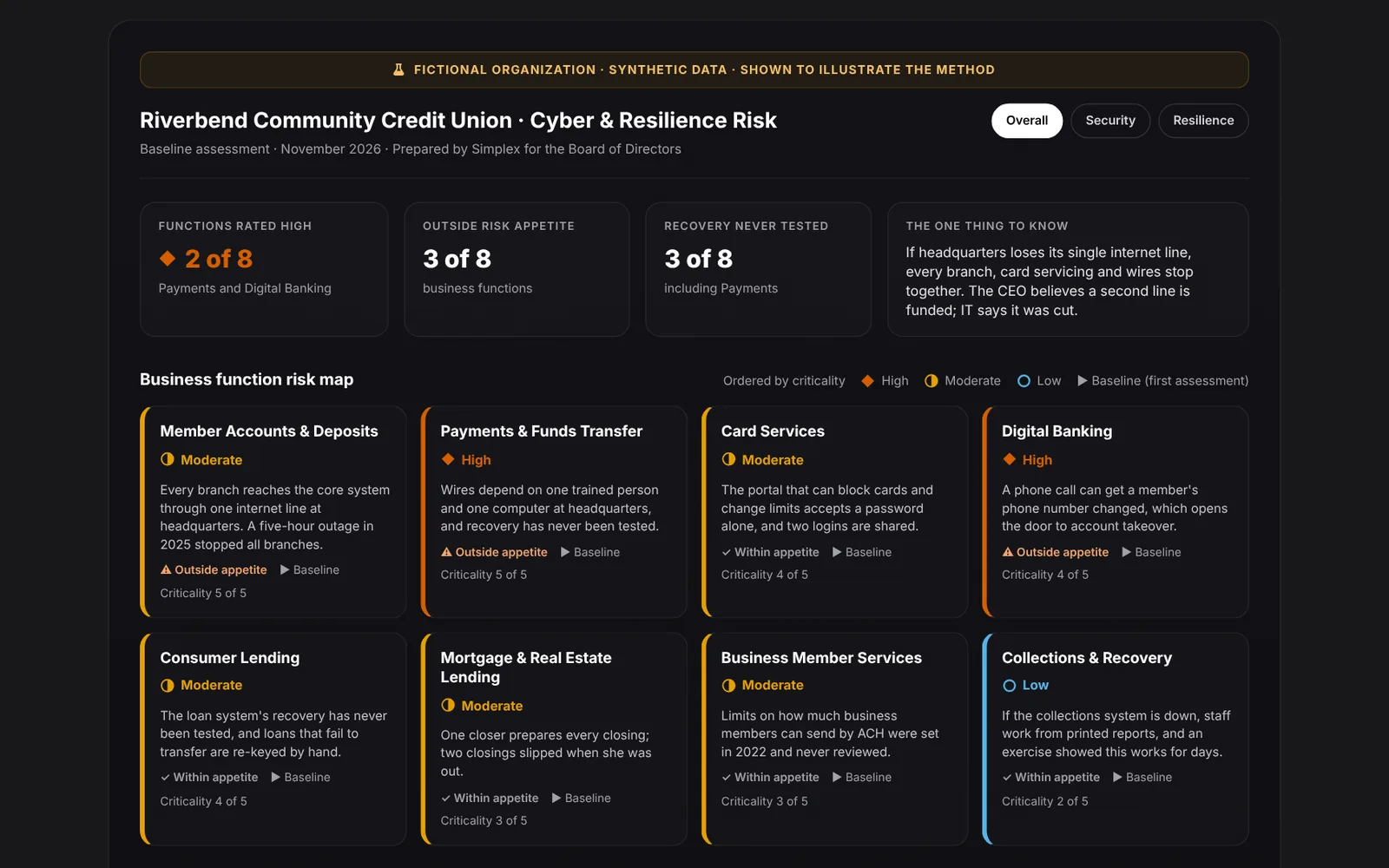
Riverbend: what a Part 748 conversation looks like with evidence.
Riverbend Community Credit Union is a $612 million institution we invented to demonstrate the method end to end. Its findings show exactly where policy and practice part ways:
- Third-party prong of § 748.1(c): online banking, the website and email all depend on one outside internet-name provider that had never been assessed. A compromise there could start the 72-hour clock.
- Dual control (App. A III.C): wire approvals are dual control on paper, but the backup approver's token had not been used in nine months.
- Testing (App. A III.C): Payments said it could recover in two hours. That had never been demonstrated.
- Access controls: six everyday accounts, including the IT provider's, held full network control and could also open the backup system.
Built for the three people who answer for Part 748.
Board member
You approve the program and receive the report. You get a ten-minute view that answers:
- Which member services are at risk, and how much?
- Are we inside the risk appetite we set?
- Can we recover in time?
- What do you need from us?
CEO
You sign the certification and own the budget. You get:
- Confidence behind the signature
- A ranked list of where spending reduces the most risk
- Clear owners for every open item
- No surprises at the next exam
Head of cybersecurity
You run the program and face the examiner. You get:
- Independent network evidence of what really connects
- Control gaps tied to the processes they put at risk
- Vendor dependencies for the 72-hour decision
- A board report you didn't have to build by hand
Compliance is the floor. Here's what else you get.
Exam readiness
Our evidence lines up with NCUA's Information Security Examination and its voluntary ACET maturity assessment. NCUA is updating ACET toward NIST CSF 2.0 and CISA's Cybersecurity Performance Goals.
Ransomware resilience
Knowing who talks to what across every system shows where ransomware could spread and which member services would stop, before an attacker shows you.
Key-person risk
Process maps expose work that rests on one employee, so cross-training and succession get funded before someone leaves.
Process modernization
The same maps become the blueprint for strengthening and automating member services, with controls built in rather than bolted on.
Merger and vendor due diligence
Appendix A expects the program to adjust for mergers and outsourcing. A mapped baseline makes integration risk visible on day one.
Exercises that matter
Pair the findings with a VIRTEx immersive exercise built on your real worst case, such as losing headquarters on a payroll day.
The Part 748 Readiness Review.
We work transparently alongside your team, and you keep everything we build.
- STEP 1
Discover
Your CEO ranks the lines of business. Leaders walk us through people, process and technology for each.
- STEP 2
Verify
Network flow evidence confirms how systems really connect. Vendors and recovery claims are checked.
- STEP 3
Map to Part 748
Every finding is tied to the expectation it affects, with an owner and a recommended treatment.
- STEP 4
Brief the board
A board-ready report and a clear set of decisions, then reassessment so progress shows as a trend.
Give your board the evidence behind the signature.
Sources. 12 CFR Part 748 · Appendix A, Guidelines for Safeguarding Member Information · § 748.1, Filing of reports · NCUA Cyber Incident Reporting Guide · NCUA Deregulation Project (Appendix A proposal) · NCUA Information Security Examination and ACET
This page summarizes regulatory expectations for general information and is not legal advice. Compliance determinations rest with each credit union, its counsel and NCUA. Riverbend Community Credit Union is fictional.